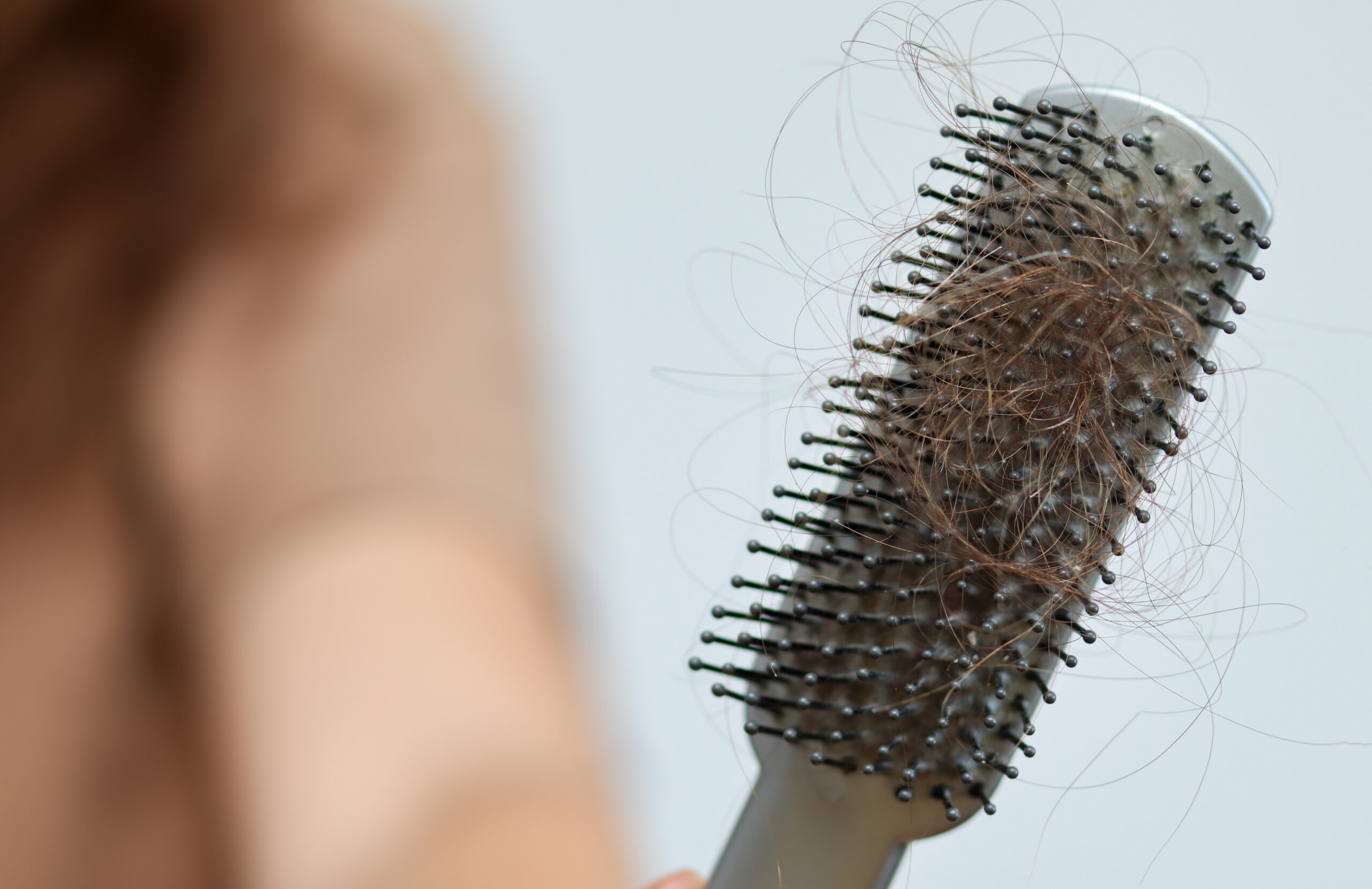
You notice it in the shower first. A fistful of hair around the drain that didn't used to be there. Then it's the ponytail, thinner than it used to feel in your hand, or the part that seems to be getting wider every time you catch your reflection in a certain light. You mention it to your doctor, and you get a shrug. Probably just stress. Or getting older. Maybe you get a referral to a dermatologist who checks your scalp for twenty seconds and tells you your labs are normal.
Meanwhile, your cycles have gone unpredictable. You're waking up at 3am for no reason. Your patience feels thinner than your hair does. Nobody connected those dots for you, and that's not because they aren't connected. They are. You're not imagining this, and you're not alone in it.
Perimenopause is one of the most common, and most consistently overlooked, causes of hair thinning in women. It's common enough that if you're in this stage of life and thinning is new, hormones deserve a real look, not a shrug.
Hair follicles are hormone-sensitive tissue. They respond to signals from estrogen, progesterone, and testosterone the same way your skin, bones, and mood do, which is exactly why hair changes tend to show up alongside the hot flashes and sleep disruption, not separately from them.
Estrogen and progesterone support the growth phase of the hair cycle, called anagen. When their levels start to fluctuate and gradually decline during perimenopause, often five to ten years before your final period, hair follicles spend less time in that growth phase and shift into the resting and shedding phases more readily. The result is hair that grows more slowly, sheds a bit more than it used to, and comes in finer than before.2
Total testosterone doesn't necessarily rise during perimenopause, but because estrogen is dropping faster, the ratio between estrogen and androgens (a hormone group that includes testosterone) shifts in a way that can make hair follicles more sensitive to androgen signaling. That's the same basic mechanism behind androgenetic alopecia, the inherited pattern hair loss more commonly discussed in men. It's part of why perimenopausal thinning sometimes looks like a milder version of pattern loss: a widening part, more scalp visible at the crown, without dramatic shedding anywhere else.
Hormonal thinning is almost always gradual and diffuse, not sudden or patchy, which is exactly why it's so easy to write off as stress or aging instead of investigating it.
Perimenopause doesn't happen in isolation from the rest of your body, and neither does the hair loss that comes with it. A thorough evaluation looks at several overlapping systems, not just one hormone panel.
Thyroid dysfunction, both underactive and overactive, becomes more common in the same decade of life as perimenopause, and the two can look nearly identical on the surface: fatigue, weight changes, mood shifts, and diffuse hair thinning. Because the symptom overlap is so significant, a hormonal hair loss evaluation should include thyroid markers (typically TSH and free T4) rather than assuming perimenopause is the whole story.3
Perimenopause tends to land in the middle of an unusually demanding stretch of life: aging parents, teenagers or young adult kids, career pressure, disrupted sleep from night sweats. That chronic stress load raises cortisol, which can push additional hair follicles into a shedding phase on top of whatever the hormonal shift is already doing. This is a second, additive mechanism, called telogen effluvium, layered on top of the hormonal one rather than a replacement for it.
Iron, ferritin, vitamin D, and B12 levels are all relevant to hair growth, and all three can shift during this decade of life, whether from changes in appetite, digestion, diet, or medication use, including GLP-1 medications some women start during this same window for weight management. Low ferritin in particular is a frequently missed contributor to hair thinning that a general hormone panel alone won't catch.45
of postmenopausal women in a 2022 study reported measurable female pattern hair loss, most of it mild to moderate.1
Hormonal thinning is easy to second-guess, because it builds slowly. If several of these sound familiar, it's worth treating as a real pattern rather than a coincidence.
Perimenopausal hair loss can look similar to a couple of other common patterns, which is exactly why it gets misattributed in both directions. Here's how they typically differ.
| Pattern | Typical onset | What it looks like | What confirms it |
|---|---|---|---|
| Hormonal (perimenopause) | Gradual, over months to a few years | Diffuse thinning, widening part, often alongside other perimenopause symptoms | Hormonal timeline review, thyroid panel, magnified scalp analysis |
| Telogen effluvium (stress, illness, rapid weight change) | Sudden, usually 2 to 4 months after a trigger event | Diffuse shedding across the whole scalp, no specific pattern | Timeline connected to a specific trigger; typically temporary |
| Genetic (androgenetic alopecia) | Gradual, can begin at any adult age | Patterned thinning, often crown or part-line specific; family history common | Follicle density and miniaturization mapping under magnification |
"I've noticed increased shedding and thinning over the past few months. Given where I am in perimenopause, can we check my thyroid panel, ferritin and iron levels, and vitamin D as part of this evaluation, not just estrogen and progesterone?"
Bringing a specific, written ask like this to an OB/GYN, primary care, or trichology appointment makes it much harder to get waved off with a general reassurance. You're allowed to ask for the full picture, not just one piece of it.
The right next step depends on how far along the thinning is and what else is going on hormonally. None of these stages requires guessing on your own.
If you're noticing early changes, texture shifts, a little extra shedding, but nothing dramatic yet, this is a reasonable point to add a scalp-supportive topical alongside getting bloodwork started. DE|RIVE®MD Hair Support Serum from We Grow Hair USA is formulated to support a healthier scalp environment for growth, and it's a reasonable at-home layer to start on its own timeline while your evaluation is underway. It's not a substitute for finding out what's driving the thinning, but it doesn't have to wait for that answer either.
Shop DE|RIVE®MD Hair Support SerumOnce thinning is visible to you consistently, not just on bad hair days, it's worth a proper evaluation: magnified scalp analysis, a hormonal and health history review, and a conversation about whether bloodwork would clarify what's happening. This is where hormonal thinning gets distinguished from genetic pattern loss or a stress-driven shedding phase, which matters because they don't respond to the same approach.
See how we evaluate women's hair lossFor more advanced thinning, the plan often involves coordinating with your OB/GYN or primary care provider on hormonal management, including HRT if that's the right fit for you, alongside a clinical hair restoration plan built around your specific pattern. You don't have to choose between addressing the hormones and addressing the hair. A full evaluation accounts for both.
Explore hair restoration options for womenWhether you're just starting to notice changes or you've been dismissed already, a scalp evaluation gives you something concrete to work from.

